
Send airflow, pollutant type, material preference, voltage and destination. PureAirTek will recommend suitable industrial equipment and quote range.
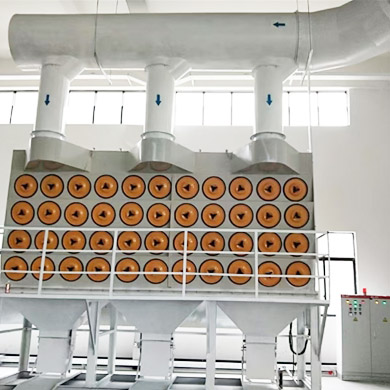
A cartridge dust collector is a compact filtration system for fine dry dust, welding fumes, cutting smoke, grinding dust and workshop air filtration. Compared with a baghouse, it uses pleated cartridge filters to provide a larger filtration area inside a smaller cabinet. This makes it useful when the factory needs strong local capture, limited floor space and convenient filter replacement.
| Process | Typical Pollutant | Why Cartridge Filtration Fits |
| Welding and polishing | Fine metal fumes and oxide dust | High filter area and pulse cleaning help maintain airflow in compact workshop systems. |
| Laser and plasma cutting | Fine smoke, metal dust and thermal particles | Cartridge filters work well when spark protection and pre-separation are considered. |
| Grinding and sanding | Fine dry dust | Large pleated media area supports efficient capture without a very large footprint. |
| Powder handling | Dry powder dust | Modular cartridges can be selected by dust type, particle size and cleaning frequency. |
Cartridge collectors are not ideal for sticky paint mist, wet dust, high-moisture exhaust or heavy abrasive dust loading without proper pre-treatment. For large continuous dust loads, a baghouse may be more stable. For explosive or combustible dust, antistatic media, explosion venting, isolation and local safety rules must be reviewed before equipment selection.
| Parameter | What to Confirm | Effect on Design |
| Airflow | Total hood airflow and number of dust points | Determines collector size, inlet layout and fan pressure. |
| Dust type | Metal, mineral, powder, fume, combustible or abrasive dust | Determines filter media, spark control and discharge method. |
| Moisture and oil | Dry, humid, oily or sticky exhaust | Decides whether cartridge filtration is suitable or needs pre-treatment. |
| Pressure drop | Initial and operating resistance | Impacts fan selection, energy use and maintenance timing. |
| Maintenance access | Filter replacement side, dust bin location and compressed air access | Affects real operating cost after installation. |
A complete system normally includes capture hood or suction arm, ductwork, spark arrestor when needed, cartridge dust collector, pulse-jet cleaning system, dust drawer or hopper, fan, control panel and exhaust stack. For cutting or welding applications, the inlet velocity, spark risk and filter media temperature limit should be checked together instead of selecting only by airflow.
Please provide process type, dust source quantity, required airflow, dust material, temperature, humidity, operating hours, workshop layout, available compressed air, voltage and destination country. Photos or drawings of the dust source help PureAirTek recommend the collector structure, filter media and fan pressure more accurately.
Contact:
Phone:
Email: sales@pureairtek.com
Add:
We chat