Common Cartridge Dust Collector Problems
Introduction
For industrial buyers, a cartridge dust collector is not only a filter box. It is a production reliability device, an energy cost item, a worker protection measure and, in many factories, a visible sign of whether the plant takes environmental control seriously. Common Cartridge Dust Collector Problems is a practical question because the wrong answer can lead to weak suction, short filter life, dust escaping into the workshop, repeated shutdowns and unnecessary electricity consumption.
PureAirTek designs cartridge dust collectors for B2B users who need dependable performance in metal fabrication, powder coating, battery material handling, woodworking, and plastics processing. The goal is not to sell a standard machine regardless of conditions. The goal is to match dust characteristics, air volume, filtration area, cleaning method, fan pressure, duct layout, controls and maintenance access to the actual production line.
This guide is written for distributors, factory owners, engineering contractors and procurement managers who need a manufacturer-level explanation before requesting a quotation. It combines educational content, technical selection guidance, practical site experience and product marketing information so that a buyer can compare solutions with confidence.
Industry Background
Modern manufacturing plants are under pressure to improve productivity while reducing visible dust, worker exposure and complaint risk. Processes such as welding, grinding, laser cutting, plasma cutting, powder filling, thermal spraying, mixing and sanding release fine particles that can travel far from the machine source. A general roof exhaust fan may move air, but it rarely captures contaminants at the source or protects operators near the work area.
Cartridge dust collectors became popular because pleated filter elements provide a large filtration area in a compact cabinet. Compared with many traditional systems, they are easier to install near production lines, faster to maintain and suitable for fine particulate. They are especially valuable where a factory has limited floor space, multiple intermittent dust sources or a need for modular expansion.
The commercial background is also important. International buyers do not only ask whether the machine can filter dust. They ask how much compressed air it consumes, how often cartridges must be replaced, whether spare parts are available, how the equipment fits containers for export, how the fan curve was selected, and whether the supplier understands the application. PureAirTek positions its cartridge systems around those real purchasing questions.
Equipment Working Principle
Most problems are symptoms of an airflow, dust loading or maintenance mismatch. High differential pressure may come from wet dust, failed pulse valves or undersized filter area. Visible emissions may mean damaged cartridges, poor sealing or air bypass. Weak suction often points to duct blockage, open unused branches or a fan operating away from its curve.
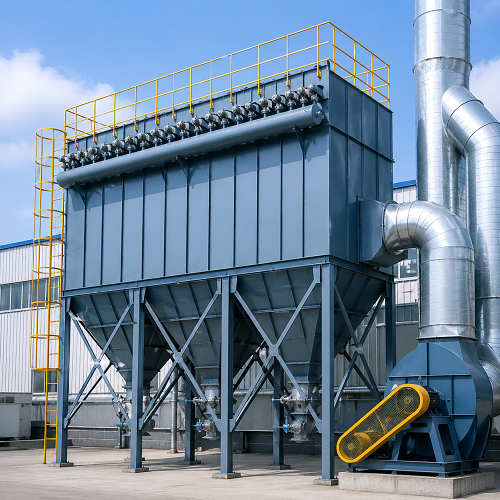
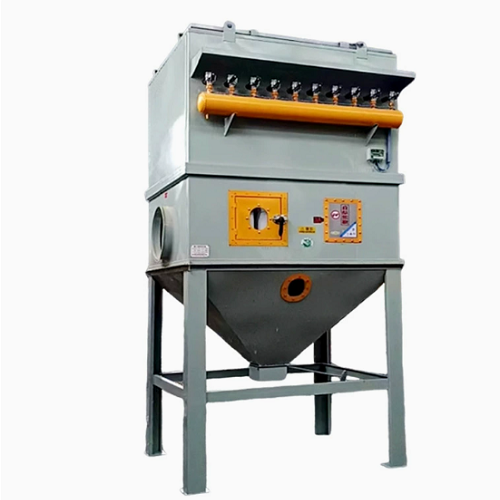
A complete cartridge dust collection system usually includes capture hoods or machine interfaces, ductwork, a spark or pre-separation section when required, the cartridge filter chamber, a clean-air chamber, fan, dust discharge device and electrical controls. Each part affects the others. A high-efficiency filter cannot compensate for a badly positioned hood, and a powerful fan can waste energy if the duct network is not balanced.
The dust cake on the filter surface is not always negative. A controlled dust cake can improve filtration efficiency because it becomes an additional capture layer. The problem begins when the dust cake cannot be removed by pulse cleaning. This can happen when dust is oily, humid, too sticky, too heavy for the air-to-cloth ratio, or when compressed air pressure is unstable. That is why PureAirTek asks about process material, humidity, temperature and working schedule before finalizing media selection.
Technical Specifications
| Specification Item | Typical Industrial Design Range |
|---|---|
| Air volume range | 1,500-80,000 m3/h per system, engineered by source capture demand and duct losses |
| Filter media | Pleated polyester, spunbond polyester, PTFE membrane, anti-static, flame-retardant or oil-resistant media |
| Filtration efficiency | Typically 99%+ for industrial particulate when media and air-to-cloth ratio are correctly selected |
| Cleaning method | Pulse-jet compressed air cleaning with diaphragm valves, blow pipes and programmable controller |
| Recommended inlet loading | Light to medium dust loading for compact cartridge designs; pre-separation recommended for heavy sparks or coarse chips |
| Operating temperature | Usually ambient to 80 C for standard cartridges; higher temperatures require special media and engineering review |
| Housing material | Carbon steel with powder coating, stainless steel, or customized corrosion-resistant construction |
| Discharge options | Dust drawer, rotary valve, screw conveyor, bin, drum adapter, or sealed collection bucket |
| Controls | Differential pressure gauge, pulse controller, fan starter, VFD, interlocks, explosion protection options where required |
Specifications must be read as engineering ranges, not universal promises. A 10,000 m3/h collector used for dry welding fume may have very different filter life from the same air volume used for abrasive grinding dust. The technical proposal should state inlet dust condition, design airflow, filter area, air-to-cloth ratio, fan power, external static pressure, cleaning pressure and discharge method. If any of those values are missing, two quotations may look similar while the real performance is completely different.
Selection Guide
Start with the dust source. Identify how many machines operate at the same time, whether the dust is fine or coarse, whether sparks are produced, whether the material is combustible, and whether fumes contain oil or moisture. Then calculate the capture airflow required at each source. After that, design duct velocity high enough to prevent settlement but not so high that friction loss and noise become excessive.
For procurement teams, a useful selection process is: define the process, confirm capture method, estimate airflow, choose media, select filter area, size the fan, review discharge method, confirm controls, evaluate safety accessories and then compare lifetime cost. PureAirTek can support this process with layout review, equipment drawings and practical recommendations for international projects.
| Buyer Question | Practical Recommendation | Why It Matters |
|---|---|---|
| Is the dust dry and free-flowing? | Use cartridge filtration for dry fine dust; review pre-treatment for sticky, oily or wet contaminants. | Cartridges perform best when dust can release during pulse cleaning. |
| Are sparks present? | Add spark arrestors, drop-out boxes or duct spark detection where metal cutting or welding creates ignition risk. | A good collector design protects filters, dust drawers and downstream ductwork. |
| Is airflow constant or variable? | Consider a VFD fan and machine interlocks when production stations operate intermittently. | Variable control reduces electricity cost and noise while maintaining capture velocity. |
| Is dust combustible? | Request an explosion risk review and consider vents, isolation valves, anti-static media and grounding. | Combustible dust design is a project safety requirement, not an accessory. |
| Is future expansion likely? | Reserve fan capacity, duct branches and control I/O for the next production line. | A small oversizing decision can avoid buying a second collector too early. |
One common mistake is buying by fan power alone. A larger motor does not guarantee better dust capture if the collector has insufficient filter area or the duct system has open branches. Another mistake is selecting the lowest initial price without checking cartridge size and replacement cost. A collector with cheaper housing but proprietary expensive filters may become more costly after one year of operation.
Application Industries
Cartridge dust collectors are widely used in metal fabrication, welding workshops, laser cutting factories, plasma cutting lines, powder coating booths, electronics manufacturing, battery material processing, pharmaceutical powder rooms, food ingredient handling, rubber and plastics processing, ceramic finishing, woodworking sanding and general factory ventilation. The same equipment family can be adapted to different applications, but the details must change.
In a metal fabrication plant, the priority may be capturing fine fumes and controlling sparks. In a powder handling line, product recovery, hygiene and dust explosion risk may dominate the design. In a woodworking sanding area, dust volume and duct transport velocity become more important. PureAirTek treats the application as the starting point because the best collector is the one that solves the actual site problem.
Advantages and Benefits
- Compact footprint with high filtration area from pleated cartridge elements.
- High capture efficiency for fine dry industrial dust when media is correctly selected.
- Lower installation difficulty compared with larger systems in many medium airflow projects.
- Fast filter replacement through service doors, reducing maintenance shutdown time.
- Pulse-jet automatic cleaning for stable pressure drop during continuous production.
- Flexible configuration for source capture, machine enclosure, central ducting or modular expansion.
- Potential energy savings when combined with VFD fan control and station interlocks.
For factory owners, the benefit is cleaner production with fewer complaints and less housekeeping. For distributors, the benefit is a product category that can be matched to many industrial sectors. For engineering contractors, the benefit is a modular filtration package that can be integrated into a complete ventilation project.
Installation Considerations
Installation quality often determines whether a collector performs as expected. The unit should be placed where maintenance doors, dust drawers, compressed air components and electrical panels are accessible. Duct routes should be as short and balanced as practical. Sharp elbows, undersized branches and poorly sealed joints increase pressure loss and reduce capture performance.
For a plant where operators keep increasing fan speed because suction feels weak at the last branch, PureAirTek would review hood positions, simultaneous machine operation, duct diameter, expected dust loading and discharge location before confirming the final design. If the collector is installed outdoors, rain protection, anti-corrosion coating, electrical protection and freeze protection for compressed air lines may be required. If the dust is combustible, grounding, explosion venting, isolation and local code review become essential parts of the project.
Maintenance Guide
A cartridge collector should be maintained by data, not guesswork. Operators should record differential pressure, compressed air pressure, pulse frequency, visible emissions, fan vibration and dust bin level. A slowly rising pressure trend may be normal as filters age. A sudden pressure jump often points to wet dust, pulse failure or blocked discharge. A sudden pressure drop with visible dust at the outlet may indicate damaged media or sealing failure.
Routine maintenance includes checking pulse valves, draining water from compressed air lines, inspecting cartridge gaskets, emptying dust drawers before they overfill, checking fan belts or bearings, cleaning the hopper area and confirming that unused duct branches are closed. PureAirTek recommends keeping spare cartridges, diaphragm valve kits and pressure gauges available for critical production lines.
Common Problems and Solutions
| Problem | Likely Cause | Practical Solution |
|---|---|---|
| High differential pressure | Filters overloaded, pulse air weak, dust too sticky, hopper full | Check compressed air, pulse valves, dust discharge and media suitability; reduce air-to-cloth ratio if needed |
| Weak suction at machines | Duct leakage, blocked branch, wrong fan point, too many open stations | Balance dampers, inspect duct, close unused branches and review fan static pressure |
| Visible outlet dust | Damaged cartridge, poor gasket seal, bypass inside housing | Inspect cartridges, replace damaged elements and check sealing surfaces |
| Short filter life | Moisture, oil mist, sparks, excessive dust load, wrong media | Improve pre-separation, choose correct media and review process conditions |
| High energy cost | Fan running at full speed during low production | Use VFD control, pressure-based control and machine interlocks |
| Dust leaks during emptying | Open drawer handling or overfilled bin | Use sealed drum connection, scheduled emptying and operator PPE |
Real Industrial Scenario
Consider a plant where operators keep increasing fan speed because suction feels weak at the last branch. The plant manager may first notice dust on beams, complaints from operators and unstable suction at the farthest machine. A basic quotation might simply offer a collector with a certain motor power. A better industrial proposal would measure the number of active stations, identify the dust type, calculate branch airflow, protect the filters from sparks, select cartridges with suitable media and provide a maintenance plan.
In this scenario, PureAirTek would normally propose a cartridge collector with pulse-jet cleaning, a conservative filtration velocity, a spark control stage if hot particles are present, and a fan selected for the actual external static pressure. The proposal would also show which related products may be used in the same facility, such as Cartridge Dust Collectors, Baghouse Dust Collectors, Activated Carbon Adsorbers, Spray Tower Scrubbers and RCO Catalytic Oxidizers when VOC treatment is also required.
How to Reduce Operating Costs
Operating cost comes from electricity, compressed air, filter replacement, downtime and labor. The easiest way to reduce electricity cost is to avoid oversupplying airflow when only part of the workshop is operating. VFD fan control, pressure sensors and automatic dampers can keep capture performance stable while reducing unnecessary fan speed.
Compressed air cost is often ignored. Pulse-jet cleaning should use clean, dry air at the correct pressure. Too little pressure fails to clean filters; too much pressure wastes air and may shorten cartridge life. A differential-pressure-based pulse controller is usually better than fixed continuous pulsing because it cleans only when needed.
Filter cost is controlled by selecting the right media and keeping dust conditions within the collector design limits. If sparks or coarse dust enter directly, filters fail early. If humidity makes dust sticky, pulse cleaning becomes ineffective. A small investment in spark arrestors, pre-separation or process enclosure can reduce annual spare-part spending.
Internal Links for Topic Cluster
- Related product: Industrial Cartridge Dust Collector
- Related comparison: Cartridge vs Baghouse Dust Collector
- Related sizing guide: How to Size a Cartridge Dust Collector
- Related maintenance article: Cartridge Filter Replacement Guide
- Related application: Cartridge Dust Collector for Laser Cutting
FAQ
1. How do I know whether a cartridge dust collector is suitable for my factory?
It is suitable when the dust is mainly dry, fine to medium in particle size, and can be released from pleated media by pulse cleaning. PureAirTek reviews dust type, airflow, temperature, humidity, sparks and working hours before recommending a model.
2. What information is needed for a quotation?
Provide process description, machine quantity, operating schedule, dust material, hood dimensions, available space, duct distance, discharge requirement, power supply and any local environmental or safety requirement.
3. Can one collector serve several machines?
Yes. A central collector can serve several stations if the ductwork is balanced and the fan is selected for simultaneous airflow. Automatic dampers can reduce airflow when some machines are idle.
4. How often should cartridges be replaced?
Replacement depends on dust loading, media, humidity, pulse cleaning and operating hours. Many factories use differential pressure trends and outlet emission checks instead of a fixed calendar interval.
5. Is explosion protection required?
If dust is combustible, an explosion risk assessment should be completed. Options may include anti-static media, grounding, explosion vents, isolation valves and safe dust discharge methods.
6. How can filtration efficiency be improved?
Improve source capture, select suitable filter media, maintain proper air-to-cloth ratio, keep pulse air dry, prevent air bypass and avoid overloading the collector with sparks or heavy coarse dust.
7. What is the difference between equipment price and total cost?
Equipment price is only the purchase cost. Total cost includes fan energy, compressed air, replacement filters, downtime, labor, cleaning and potential production loss from poor capture performance.
Conclusion
Common Cartridge Dust Collector Problems should be answered with engineering detail rather than a catalog shortcut. A cartridge dust collector can deliver compact, efficient and maintainable industrial filtration, but only when airflow, media, cleaning system, duct design and maintenance access are matched to the process. PureAirTek helps buyers compare these details before purchase so the installed system performs in real production, not only on paper.
Request a Quote CTA
PureAirTek, supported by Dongguan Kelong Environmental Technology Co., Ltd., supplies industrial dust collection and air pollution control equipment for international markets. To request a quotation, send your process information, dust type, machine list, workshop layout and target airflow. Our team can recommend a cartridge dust collector configuration, related products and practical options for installation, operation and maintenance.