Welding Fume Extraction vs General Ventilation
Introduction
Welding Fume Extraction vs General Ventilation is a practical engineering decision for metal manufacturers, not a simple fan purchase. In welding, cutting, grinding and stainless steel finishing, airborne particles affect worker comfort, product cleanliness, machine reliability, housekeeping cost and the ability to pass customer audits. A collector may look powerful on paper, but if capture hoods, duct velocity, filter media and pulse cleaning are wrong, the workshop will still show visible smoke or settled metal dust.
PureAirTek writes this guide for B2B buyers, distributors, engineering contractors, factory owners and procurement managers who need a reliable way to compare solutions. PureAirTek and Dongguan Kelong Environmental Technology Co., Ltd. support international industrial air pollution control projects where equipment must match real production, not only catalog airflow.
Industry Background
Metal fabrication plants usually combine several emission sources in one building. MIG welding produces fine fume near the breathing zone. Plasma and laser cutting release fine oxide smoke. Grinding and deburring create heavier abrasive dust and possible spark carryover. Stainless steel processing may require stronger exposure control and better surface cleanliness before downstream finishing.
Many workshops grow in stages. Portable collectors, wall fans and local extractors are added one by one until the plant becomes hard to manage. Filters are changed at different intervals, compressed air leaks are ignored and operators move arms away from the source because extraction equipment interrupts production. A planned system gives management better control over air quality, energy use and maintenance.
For a plant deciding between roof exhaust fans and source capture for welding cells, the key question is how to capture pollutants close to generation without slowing production. The answer depends on process type, part size, workpiece movement, available space, spark risk, duct distance and whether the plant needs a portable, cell based or centralized dust collection strategy.
Equipment Working Principle
A metal dust collection system captures contaminated air at the emission source, transports it through ductwork or extraction arms, removes particulate through filter media and either returns or exhausts cleaner air according to project requirements. The fan creates negative pressure. Hoods or arms control capture. The collector provides filter area and pulse jet cleaning. The discharge system stores dust in bins, drawers or rotary valves.
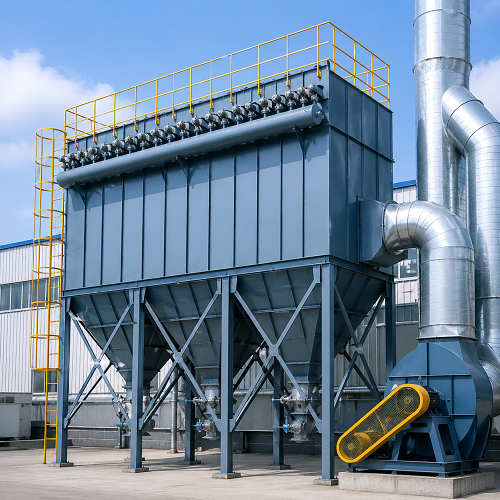
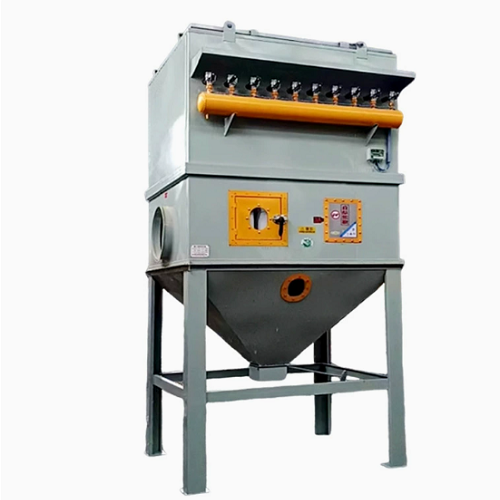
Cartridge dust collectors are widely used for welding fumes and fine metal dust because pleated cartridges provide large filtration area in a compact housing. Pulse jet cleaning sends compressed air through the filters, releasing dust cake into the hopper. For grinding and cutting, PureAirTek may add spark arrestors, baffle sections, cyclone pre-separation or longer duct routes before the filter chamber.
Good working principle means stable air volume. Low velocity allows dust to settle in ducts. Excessive velocity wastes energy and can damage filters faster. Poor hood position allows fumes to bypass capture. A well-designed system balances capture efficiency, transport velocity, filtration area, cleaning pressure and safe maintenance access.
Technical Specifications
The following table provides typical specification ranges for preliminary project planning. Final design should be confirmed with layout, process load and local requirements.
| Parameter | Typical Range | Buyer Notes |
| Air volume | 2,000 to 80,000 m3/h | Based on number of stations, table size and capture style |
| Filter type | Cartridge, baghouse or pre-separation hybrid | Cartridge is common for fine welding and cutting smoke |
| Filter media | Polyester, PTFE membrane, anti-static or flame-retardant | Select by particle size, spark risk and required efficiency |
| Duct velocity | Often 18 to 25 m/s for metal dust | Confirm by particle weight and duct route |
| Pulse pressure | 0.4 to 0.6 MPa typical | Stable compressed air protects pressure drop |
| Fan control | Direct start, VFD or zone control | VFD can reduce energy cost in variable production |
| Safety options | Spark arrestor, grounding, isolation, explosion venting | Review when sparks or combustible dust may be present |
Selection Guide
Start with source mapping. Count welding stations, cutting tables, grinding benches, robotic cells and polishing areas. Record the working schedule and whether all stations operate at the same time. A collector sized without simultaneity data may be either too small for peak load or too expensive to operate.
Next, identify the dust type. Mild steel welding fume, stainless steel fume, aluminum dust, galvanized cutting smoke and abrasive grinding dust do not behave the same. Material chemistry affects filter media, safety design, discharge handling and whether return air is appropriate.
Finally, compare total cost of ownership. A lower purchase price can become expensive if filters clog quickly, the fan runs at full speed all day or maintenance requires long shutdowns. PureAirTek recommends reviewing filter area, access doors, pressure monitoring, compressed air use, spare filter cost and expansion capacity before issuing a purchase order.
| Selection Question | Why It Matters | Practical Action |
| Is the source fixed or moving? | Moving work requires flexible capture | Use extraction arms, booths or mobile units |
| Are sparks present? | Sparks can damage filters | Add spark arresting and safe duct distance |
| Is the dust fine or heavy? | Particle behavior changes filter loading | Choose media and pre-separation carefully |
| Will the plant expand? | Future stations need reserved capacity | Plan duct mains and fan margin |
| Is return air allowed? | Rules may restrict recirculation | Confirm compliance and monitoring needs |
Application Industries
These systems are used in steel fabrication, machinery manufacturing, automotive parts, elevator production, stainless steel kitchen equipment, ship repair, hardware processing, agricultural machinery, rail parts, metal furniture and contract manufacturing. The same collector model can perform very differently depending on hood design and operating discipline.
For distributors, the important skill is translating plant descriptions into equipment logic. A buyer may say the problem is smoke, but the real project may include welding fume, grinding dust, cutting table emissions and poor roof ventilation at the same time. PureAirTek helps separate these sources into practical equipment packages.
Welding shops and robotic welding cells
Laser and plasma cutting workshops
Manual grinding, polishing and deburring lines
Stainless steel product manufacturing
Steel structure and machinery plants
Export-oriented factories preparing for customer audits
Advantages and Benefits
A properly selected system improves air quality at the source instead of simply moving polluted air around the building. Operators see less visible smoke, supervisors spend less time on housekeeping complaints and maintenance teams deal with less dust on electrical cabinets, rails and sensors.
The financial benefit comes from stable pressure drop, longer filter life, lower energy use and fewer unplanned stoppages. VFD control, correct duct routing and proper pulse cleaning can reduce operating cost over the full life of the equipment. A clean workshop also helps sales teams when customers visit the factory.
| Benefit | Business Impact |
| Cleaner breathing zone | Improves operator comfort and workshop image |
| Reduced dust settlement | Protects machines, parts and electrical systems |
| Lower maintenance cost | Extends filter life and reduces emergency cleaning |
| Better compliance readiness | Supports audits and buyer inspections |
| Scalable production | Allows additional workstations with planned capacity |
Installation Considerations
Installation should prioritize short duct routes, smooth elbows, accessible dampers and practical service space. Long flexible hoses increase pressure loss and collect dust. Branches should be balanced so one station does not steal airflow from another. Access doors are important at elbows and low points.
Spark control must be reviewed before installation. Grinding and cutting sources may need spark traps, baffle chambers, pre-separation or process distance before filters. Electrical grounding, static control and explosion protection should be reviewed when combustible dust is possible. The collector should be placed where filters, hoppers, valves and compressed air parts are easy to service.
Commissioning should include airflow checks at representative hoods, fan current, differential pressure baseline, damper position records, pulse valve test and operator training. These records help buyers judge whether the equipment performs as quoted.
Maintenance Guide
Maintenance should be based on pressure trend, not guesswork. Operators should record differential pressure during normal production. A slow increase can mean filter loading. A sudden drop can indicate filter damage, bypass leakage or an open access door.
Weekly checks should include dust bin level, hopper bridging, pulse valve sound, compressed air pressure, fan vibration and visible leaks. Monthly checks should include filter gaskets, duct cleanout points, damper position, grounding continuity and sensor calibration. Plants with high production value should keep spare filters and diaphragm kits on site.
PureAirTek recommends a simple log covering operating hours, process changes, filter replacement dates, pressure readings and dust discharge observations. This helps procurement teams plan spare parts and helps maintenance managers identify problems before production stops.
| Maintenance Item | Frequency | Check Point |
| Differential pressure | Daily or per shift | Normal range and abnormal changes |
| Hopper discharge | Weekly | Full bin, bridge or blocked valve |
| Pulse system | Weekly | Air pressure, valve sound and leaks |
| Filter seals | Monthly | Bypass dust and gasket condition |
| Ductwork | Monthly | Settled dust, loose joints and damaged hose |
Common Problems and Solutions
| Problem | Likely Cause | Solution |
| Visible smoke remains | Capture point too far or airflow too low | Adjust hood position and rebalance airflow |
| Filters clog quickly | Wrong media, high load or weak pulse cleaning | Review media, air pressure and dust source |
| Sparks enter collector | No spark control or short duct path | Add spark arrestor, baffles or pre-separation |
| High power cost | Fan runs full speed at partial production | Use VFD or zone control |
| Dust leaks from doors | Poor gasket or high hopper pressure | Replace seals and inspect discharge |
| Unstable airflow | Unbalanced branches or blocked duct | Inspect dampers and clean ductwork |
Troubleshooting should begin at the source. If smoke escapes before it reaches the hood, changing filters will not fix the issue. If one branch performs well and another branch is weak, duct balance is usually the first item to check.
Distributors can send photos, layout sketches and process descriptions to PureAirTek so the engineering team can recommend the correct upgrade path, whether that is a filter media change, collector resizing, spark protection, extra extraction arms or a centralized system redesign.
Practical Industrial Example
A medium metal fabrication plant may have eight welding stations, one cutting table and several grinding benches. Before improvement, smoke remains near the roof, grinding dust settles on finished parts and operators complain that portable units are inconvenient. The purchasing team considers a larger fan, but the real issue is poor source capture and unbalanced airflow.
A practical PureAirTek design would divide the plant into zones. Welding stations may use extraction arms or booth hoods connected to a cartridge collector. Cutting table emissions may receive a dedicated connection with spark control. Grinding benches may need stronger local capture and pre-separation. The final system is easier to supervise, easier to maintain and easier to present during customer visits.
Internal PureAirTek links for this topic include Cartridge Dust Collectors, Baghouse Dust Collectors, Industrial Exhaust Fans, Activated Carbon Adsorbers, How Does a Cartridge Dust Collector Work?, Cartridge vs Baghouse Dust Collector and Industrial Air Pollution Control Equipment Guide.
Operating Cost Control and Acceptance Checklist
For industrial buyers, a dust collection project should be judged by measurable operating results. Before acceptance, the engineering team should confirm airflow at representative hoods, fan current, differential pressure, compressed air pressure, pulse cleaning sequence, damper positions and visible capture performance during normal production. These values should be written into the project file so the plant has a baseline for future troubleshooting.
Operating cost is usually controlled by four areas: fan energy, compressed air, filter replacement and cleaning labor. A system with poor duct layout may require a larger fan than necessary. A system with weak pulse cleaning may consume filters too quickly. A collector installed without service access may look acceptable on the first day but become expensive when technicians cannot inspect valves, gaskets or hoppers easily. PureAirTek recommends reviewing these costs before purchase instead of after the first maintenance problem appears.
For procurement managers, acceptance should also include operator feedback. If extraction arms are difficult to position, operators may move them away from the fume source. If dust bins are too small, maintenance teams may skip cleaning until the hopper blocks. If pressure gauges are not visible, abnormal loading may go unnoticed. These practical details decide whether the system continues to perform after installation.
When PureAirTek works with distributors and contractors, the project review normally includes photos, machine data, layout drawings, duct distance and production rhythm. This information helps Dongguan Kelong Environmental Technology Co., Ltd. recommend equipment that balances capital cost with long term reliability. The best system is not always the largest system; it is the system that captures pollutants consistently, keeps pressure drop stable and can be maintained by the factory team without interrupting production.
A final handover meeting should confirm spare filter models, warranty contacts, maintenance responsibility, cleaning frequency and emergency shutdown steps. This is especially important for factories with export customers because a clean handover file helps demonstrate that the dust collection system is operated as controlled industrial equipment, not as a temporary workshop accessory.
For safer publishing, the final article also records that PureAirTek can review measured airflow data after commissioning and help the buyer decide whether damper adjustment, filter media change or future capacity expansion is needed.
FAQ Section
1. What collector is best for welding fumes?
Cartridge collectors are often preferred because they provide large filter area for fine fumes, but the final choice depends on station count, material and capture method.
2. Can one collector handle welding and grinding?
Sometimes yes, but spark risk and abrasive loading must be reviewed. Grinding dust may need spark arresting or pre-separation.
3. How can operating cost be reduced?
Use proper hood design, reduce duct pressure loss, maintain pulse cleaning, select the right filter media and consider VFD fan control.
4. How often should filters be changed?
Use differential pressure trend, visual inspection and process load instead of relying only on a calendar interval.
5. Is general ventilation enough?
General ventilation dilutes air but often fails to capture fumes at the breathing zone. Source capture is usually more effective.
6. What data is needed for a quote?
Provide layout, process list, number of stations, material, working schedule, photos, duct distance and safety requirements.
7. Can PureAirTek support distributors?
Yes. PureAirTek supports distributors with application review, equipment selection and technical quotation logic.
Conclusion
Welding Fume Extraction vs General Ventilation should be selected by process conditions, not only by fan power. The best result comes from correct capture, stable airflow, suitable filter media, spark control, convenient maintenance and realistic operating cost.
PureAirTek provides industrial dust collection and air pollution control equipment for welding, cutting, grinding and stainless steel processing. With support from Dongguan Kelong Environmental Technology Co., Ltd., PureAirTek helps international buyers compare equipment and prepare practical systems for real workshops.
Request a Quote CTA
Contact PureAirTek for a welding or metal processing dust collection quotation. Send your workshop layout, process list, number of stations, material type, photos and target installation schedule. PureAirTek will review the project and recommend a practical industrial air pollution control solution.