Spray Tower vs Packed Bed Scrubber
Introduction
Spray Tower vs Packed Bed Scrubber is a practical engineering topic for factories that need to treat acidic gases, alkaline fumes, water-soluble contaminants, odor-bearing exhaust or mixed industrial exhaust before discharge. A spray tower scrubber looks simple from outside, but real performance depends on gas-liquid contact, nozzle design, chemical control, demisting, fan pressure and maintenance discipline.
PureAirTek writes this guide for B2B buyers, distributors, factory owners, engineering contractors and procurement managers who need a manufacturer-level explanation before buying wet scrubber equipment. PureAirTek and Dongguan Kelong Environmental Technology Co., Ltd. support international industrial air pollution control projects where equipment must match real exhaust conditions.
Industry Background
Spray tower scrubbers are widely used in chemical plants, acid pickling, plating, electronics, battery materials, waste gas pretreatment, odor control, metal finishing, fertilizer, laboratory exhaust and general manufacturing. Many factories use scrubbers because water or chemical solution can absorb or neutralize soluble gases and remove some mist or particulate from exhaust.
For a contractor comparing simple spray towers with packed bed scrubbers, the engineering challenge is matching the scrubber to gas composition, airflow, concentration, solubility, chemical reaction, liquid circulation and mist removal. A scrubber selected only by tower diameter may fail if the liquid distribution, nozzle coverage or residence time is poor.
Industrial buyers also care about wastewater, chemical consumption and corrosion resistance. A spray tower is part of a wider environmental system, so the project should include pump selection, tank design, dosing control, material selection, access and maintenance planning.
Equipment Working Principle
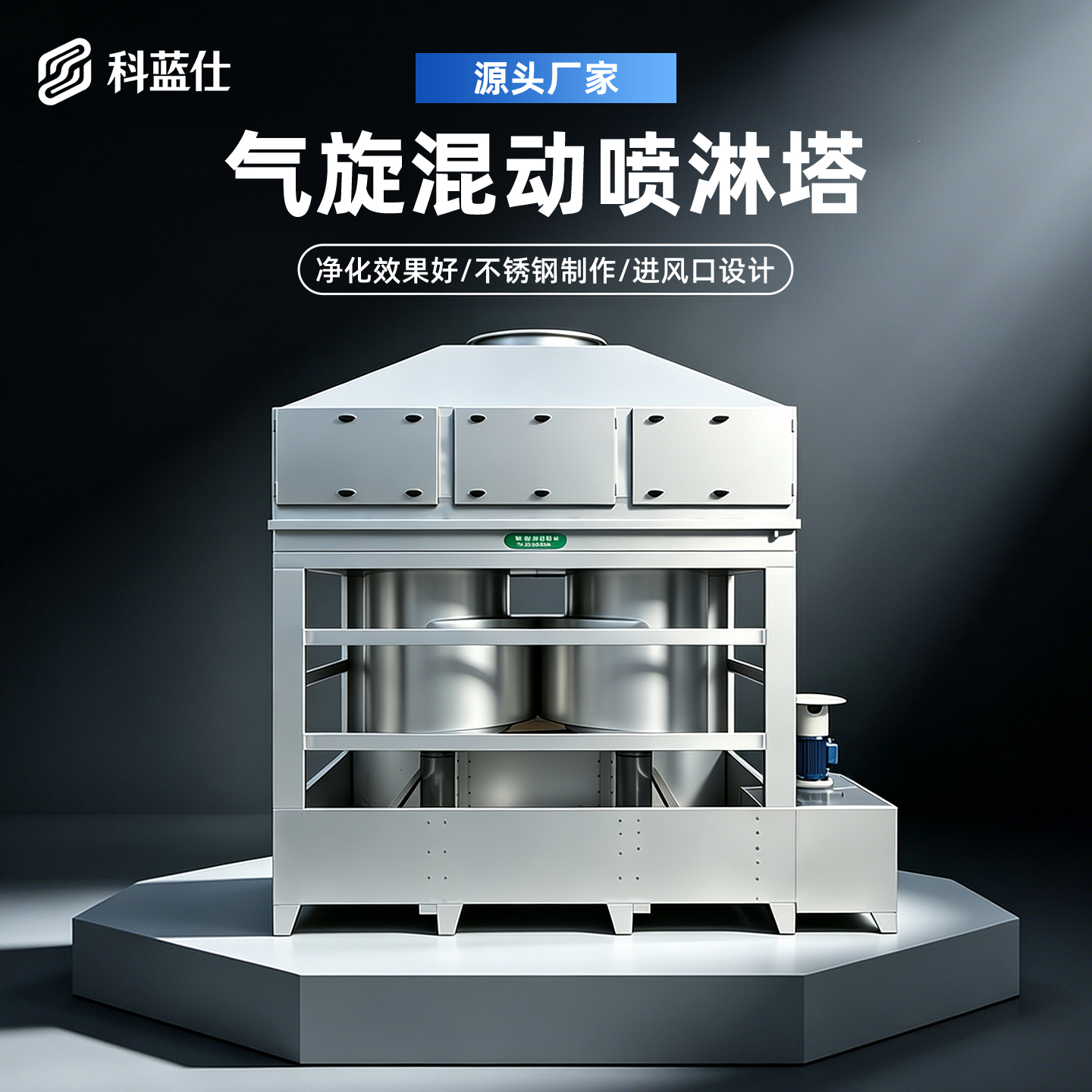
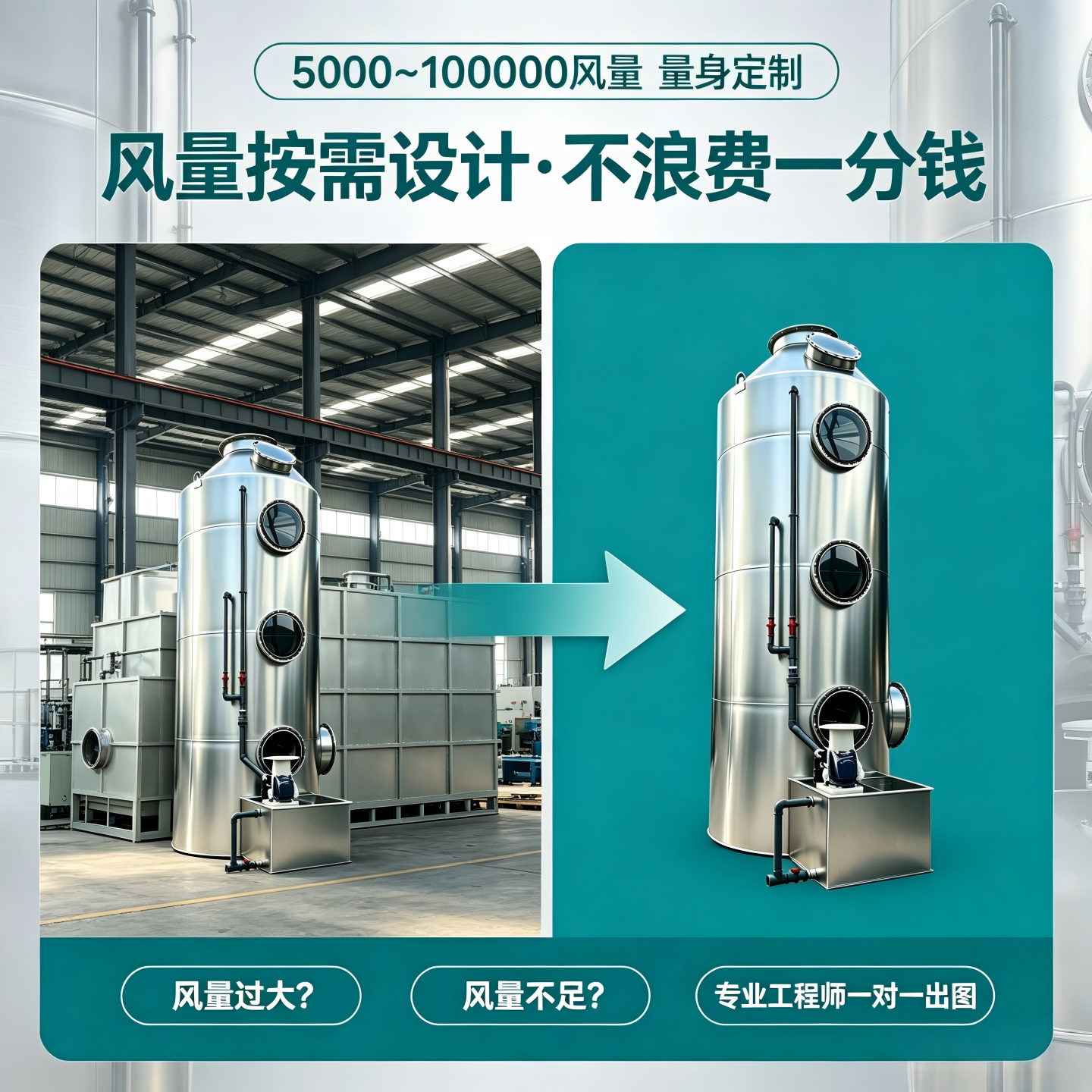
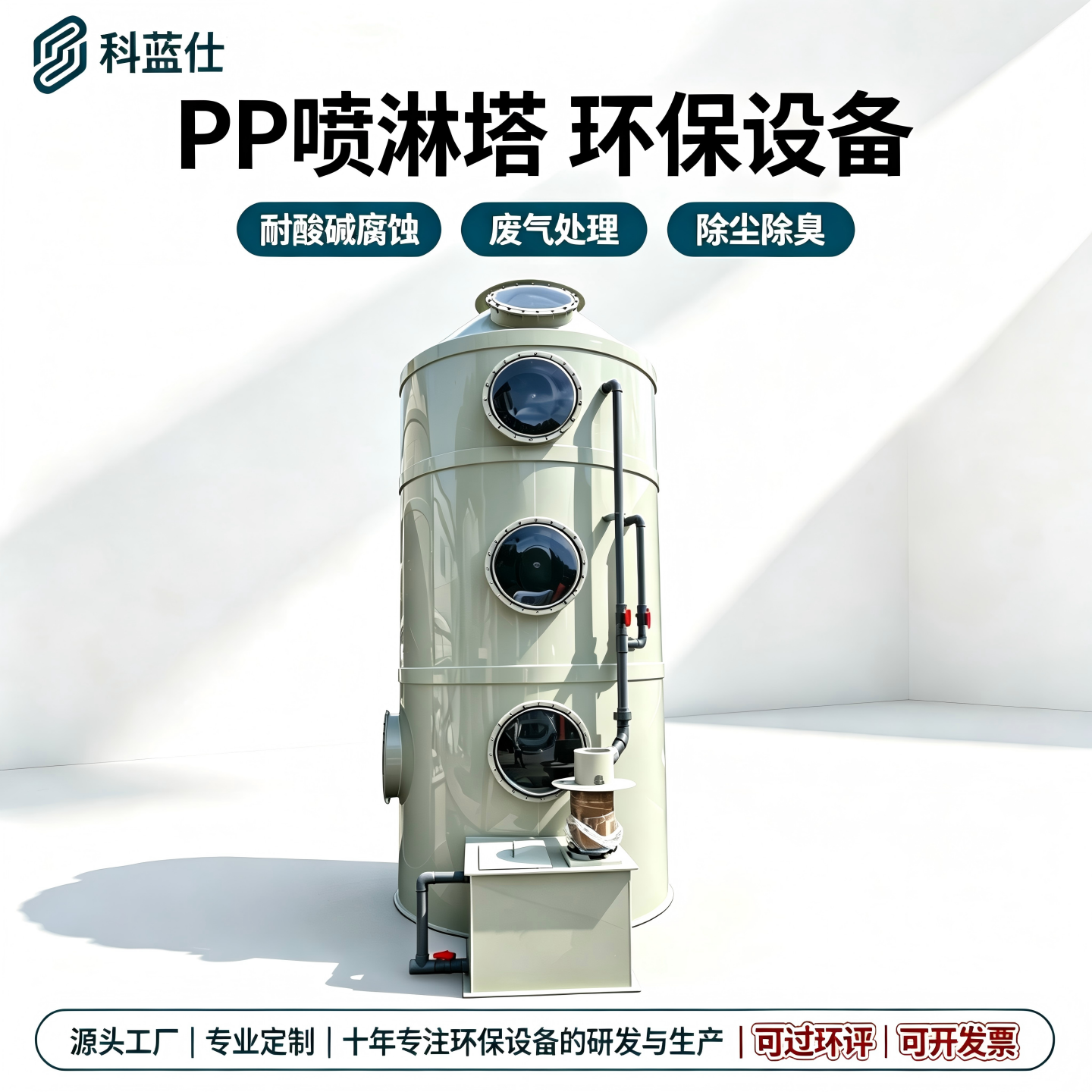
A spray tower scrubber treats exhaust by bringing contaminated gas into contact with scrubbing liquid. The exhaust enters the tower, spray nozzles distribute liquid droplets, contaminants transfer from gas into liquid, and a demister removes entrained droplets before the gas exits. The liquid recirculates through a tank and pump, and chemicals may be added to neutralize or absorb contaminants.
The working principle depends on mass transfer and reaction. Water-soluble gases can dissolve into the liquid. Acidic gases may be neutralized by alkaline solution. Alkaline gases may be treated with acidic solution. Some odor compounds require chemical oxidation or other treatment. Droplet size, spray density, gas velocity and contact time all affect efficiency.
PureAirTek evaluates airflow, contaminant type, concentration, target efficiency, chemical compatibility, tower material, nozzle type, pump capacity, demister design and fan pressure before recommending a spray tower scrubber.
Technical Specifications
The following table provides preliminary specification references for industrial spray tower scrubbers. Final values should be confirmed with exhaust data and process requirements.
| Parameter | Typical Range or Option | Buyer Notes |
| Airflow | 2,000 to 100,000 m3/h | Determines tower diameter, fan and duct size |
| Gas velocity | Project specific | Affects contact time and droplet carryover |
| Liquid-to-gas ratio | Application dependent | Controls absorption and chemical consumption |
| Nozzle type | Spiral, full cone, hollow cone or anti-clog nozzles | Select by liquid quality and spray coverage |
| Tower material | PP, FRP, stainless steel or lined steel | Choose by corrosion and temperature |
| Circulation pump | Chemical-resistant pump | Sized for spray pressure and flow |
| Demister | PP, FRP, mesh pad or blade type | Reduces droplet carryover |
| Controls | pH, ORP, liquid level, pump interlock, pressure monitoring | Improves stable operation and maintenance |
Selection Guide
Selection begins with exhaust data. Buyers should provide airflow, gas composition, concentration, temperature, humidity, dust or mist content, operating hours and target removal efficiency. Without this data, tower size and chemical system cannot be selected accurately.
Next, review the scrubbing chemistry. Acid fumes, alkaline fumes, ammonia, soluble gases and odor compounds require different scrubbing liquids and control parameters. pH, ORP, chemical dosing and wastewater handling may be necessary.
Finally, compare total cost of ownership. A low-cost tower can become expensive if nozzles clog, pump energy is high, chemical use is excessive or demister carryover causes corrosion downstream. PureAirTek recommends reviewing material, nozzle access, pump maintenance, blowdown and monitoring before purchase.
| Selection Question | Why It Matters | Recommended Review |
| What gas must be removed? | Determines water or chemical scrubbing | Provide gas composition and concentration |
| What is the airflow? | Determines tower and fan size | Measure or calculate real exhaust volume |
| Is dust or mist present? | Can clog nozzles or packing | Add pretreatment or anti-clog design |
| What material is suitable? | Corrosion affects service life | Choose PP, FRP, stainless or lining correctly |
| How will wastewater be handled? | Scrubbing transfers pollutants into liquid | Plan blowdown and treatment |
Application Industries
Spray tower scrubbers are used in chemical plants, plating lines, pickling workshops, electronics, semiconductor support processes, battery material production, fertilizer, waste gas pretreatment, odor control, laboratories and general industrial exhaust treatment.
PureAirTek helps buyers decide whether a spray tower alone is enough or whether it should be combined with activated carbon, RCO, demisting, dust filtration or other treatment equipment. Many projects use a scrubber as pretreatment before VOC adsorption or oxidation when the exhaust contains water-soluble contaminants or mist.
Chemical and acid gas treatment
Electroplating and metal surface treatment
Battery material and electronics production
Odor control and soluble gas absorption
Wet pretreatment before VOC equipment
Engineering contractors and distributors serving industrial exhaust projects
Advantages and Benefits
Spray towers are flexible, corrosion-resistant and suitable for many soluble gas or chemical fume applications. They can be configured with different materials, nozzles, chemical tanks and control systems. They can also reduce temperature and remove some mist or particulate before downstream equipment.
The business benefit comes from practical reliability. A well-designed tower reduces odor or gas emissions, protects downstream equipment, improves compliance readiness and provides a maintainable system that operators can understand.
| Benefit | Business Impact |
| Good gas-liquid contact | Supports removal of soluble or reactive gases |
| Flexible material options | Matches corrosive exhaust conditions |
| Pretreatment value | Protects carbon, catalysts and fans downstream |
| Maintainable design | Nozzles, pumps and demisters can be inspected |
| Scalable airflow range | Supports small workshops and large process lines |
Installation Considerations
Installation should consider tower foundation, pump access, tank volume, chemical storage, drain connection, duct routing, fan position, inspection doors and safe platforms. The tower should not be placed where operators cannot reach nozzles, demisters or pumps.
Ductwork should be corrosion-resistant where needed. The fan should be selected for total system pressure, including tower pressure drop, demister resistance and duct loss. If the fan is installed after the scrubber, it may need corrosion-resistant materials.
Commissioning should include airflow check, pump flow, nozzle spray pattern, liquid level, pH or ORP control, demister inspection and pressure drop baseline. PureAirTek recommends documenting these values for future maintenance.
Maintenance Guide
Maintenance focuses on nozzles, pumps, liquid quality, demisters and chemical control. Nozzles should be inspected for blockage or wear. Pumps should be checked for vibration, leakage and flow. Liquid should be monitored for pH, concentration, solids and contamination.
Demisters should be cleaned when pressure drop rises or droplet carryover appears. Blowdown should be managed so dissolved contaminants do not accumulate excessively. Chemical dosing systems should be calibrated and inspected.
PureAirTek recommends a maintenance log with pH or ORP readings, pump status, nozzle inspection, demister cleaning, chemical consumption and blowdown records. Dongguan Kelong Environmental Technology Co., Ltd. can support project review if process conditions change.
| Maintenance Item | Frequency | Purpose |
| Nozzles | Weekly or monthly | Maintain spray coverage and prevent clogging |
| Pump and piping | Weekly | Check flow, leakage and vibration |
| pH or ORP | Daily or continuous | Maintain chemical absorption efficiency |
| Demister | Monthly or by pressure | Prevent droplet carryover |
| Tank and blowdown | Routine | Control solids and chemical buildup |
Common Problems and Solutions
| Problem | Likely Cause | Solution |
| Low removal efficiency | Poor liquid distribution or wrong chemistry | Check nozzles, pH, ORP and liquid flow |
| Nozzle clogging | Solids or scale in circulation liquid | Add filtration, cleaning and blowdown control |
| Droplet carryover | High gas velocity or dirty demister | Inspect demister and airflow |
| High pressure drop | Blocked demister or duct restriction | Clean demister and inspect ducts |
| Corrosion downstream | Chemical mist carryover or wrong material | Improve demisting and material selection |
| High chemical cost | Poor control or excessive blowdown | Optimize dosing and monitoring |
Troubleshooting should begin with liquid and airflow. If liquid chemistry is wrong, the tower cannot absorb target gases efficiently. If airflow is too high, contact time falls and carryover increases.
PureAirTek can review exhaust data, tower photos, pump information and maintenance records to recommend practical corrections.
Practical Industrial Example
A plating workshop may use a spray tower to control acid mist. At first, removal is acceptable, but after several months operators notice odor and corrosion near the outlet. Inspection shows several nozzles are blocked and the demister is dirty. The tower itself is not the only problem; maintenance and liquid quality control are weak.
A PureAirTek review would check airflow, nozzle spray pattern, pH, pump flow, demister condition and blowdown practice. The solution may include nozzle replacement, better liquid filtration, pH control, demister cleaning and operator training.
Related PureAirTek resources include Spray Tower Scrubbers, Industrial Exhaust Fans, Activated Carbon Adsorbers, RCO Catalytic Oxidizers, Complete Industrial VOC Treatment Guide, VOC Monitoring and Control Guide and Industrial Dust Collection Engineering Guide.
Engineering Review and Cost Control
Before purchase, buyers should ask whether the supplier reviewed airflow, gas composition, tower velocity, nozzle coverage, pump flow, chemical control, material selection, demister design and wastewater handling. These details decide real performance.
Operating cost includes fan power, pump power, chemicals, water, blowdown treatment, nozzle replacement and maintenance labor. A low initial price can become costly if chemical use is unstable or maintenance access is poor.
During acceptance, record airflow, pressure drop, pump flow, pH or ORP, spray pattern, demister condition and outlet observation. These values create a baseline for long-term operation and customer audits.
Detailed Engineering Review and Buyer Checklist
A spray tower scrubber project should be reviewed with practical exhaust data before equipment is purchased. Buyers should confirm airflow, gas composition, target contaminants, inlet concentration, temperature, humidity, dust or mist content, operating hours, required removal efficiency and wastewater handling plan. These values influence tower diameter, nozzle selection, pump flow, chemical dosing, mist eliminator design and fan pressure.
Liquid quality is one of the most important operating details. If the circulation liquid contains too many solids, nozzles can clog and spray coverage becomes uneven. If pH or ORP is not controlled, the tower may circulate liquid without removing the target gas efficiently. PureAirTek recommends defining liquid monitoring points before installation so operators know what normal operation should look like.
Material selection should also be reviewed carefully. Acid gas, alkaline exhaust, oxidizing chemicals and high humidity can corrode unsuitable materials. PP, FRP, stainless steel and lined steel each have different strengths. The correct material depends on gas chemistry, liquid chemistry, temperature, structure and maintenance expectations.
Operating cost should include fan energy, pump energy, water, chemicals, blowdown treatment, nozzle replacement, demister cleaning and maintenance labor. A low purchase price can become expensive if chemical consumption is unstable or if maintenance access is poor. For B2B buyers, a scrubber quotation should be judged by lifecycle performance, not only tower size.
During acceptance, the project team should record airflow, tower pressure drop, pump current, spray pressure, pH or ORP, liquid level, nozzle condition, demister condition and outlet observation. These records create a baseline for future troubleshooting and help prove that the system was accepted under real operating conditions.
Additional Industrial Scenario
A chemical plant may use a spray tower to neutralize acidic exhaust from a process tank area. At first, the outlet odor is controlled, but after several weeks the operator notices corrosion near the outlet duct. Inspection shows droplet carryover because the demister is dirty and gas velocity is higher than expected. The solution is not only adding chemicals; the tower needs airflow review, demister cleaning and liquid management.
Another plant may use a spray tower before activated carbon. The scrubber reduces soluble gas and moisture-sensitive contaminants, protecting the carbon bed. PureAirTek would review whether the downstream carbon system needs demisting, reheating or additional filtration so that one treatment stage does not create a new problem for the next stage.
Commissioning and Long-Term Operation Notes
Commissioning should not be treated as a short visual inspection. A useful start-up procedure checks rotation direction of the pump and fan, spray pressure, nozzle pattern, water distribution, overflow and drain function, instrument readings, emergency stop logic and vibration. Operators should understand which values are normal because a spray tower can look wet and active even when removal efficiency is poor.
For factories with multiple process lines, the exhaust load may change during the day. The scrubber should be reviewed at low load, normal load and peak load. If the system only performs well at one airflow condition, duct balancing, fan control or liquid distribution may need adjustment. This is especially important in chemical, plating, surface treatment and odor control projects where production scheduling changes frequently.
For final handover, the buyer should receive tower drawings, pump data, nozzle specifications, demister information, control settings, chemical dosing instructions, maintenance schedule and spare part recommendations. This documentation helps operators maintain the scrubber correctly and helps procurement teams plan nozzles, pumps and chemical supplies before urgent repairs are needed.
PureAirTek also recommends a review after several weeks of production. Real pH trends, chemical consumption, pump operation, demister condition and outlet observations can show whether the original assumptions match daily operation. If the factory changes process chemistry or airflow, the spray tower should be reviewed before efficiency problems appear.
FAQ Section
1. What does a spray tower scrubber remove?
It can remove many water-soluble or chemically reactive gases, acid mist, alkaline fumes and some odor compounds depending on liquid chemistry and design.
2. Is a spray tower the same as a packed bed scrubber?
No. A spray tower uses spray droplets for gas-liquid contact, while a packed bed scrubber uses packing media to increase contact surface.
3. Can spray towers remove VOCs?
Only some water-soluble or reactive VOCs are suitable. Many solvent VOCs require activated carbon, RCO or other treatment.
4. Why do nozzles clog?
Solids, scale and poor liquid quality can clog nozzles. Filtration, cleaning and blowdown help control clogging.
5. Why is pH control important?
pH controls chemical neutralization for acidic or alkaline gases. Poor pH control reduces removal efficiency.
6. What data is needed for a quote?
Provide airflow, gas composition, concentration, temperature, humidity, target efficiency, layout and wastewater requirements.
7. Can PureAirTek help size a spray tower?
Yes. PureAirTek can review exhaust data and recommend tower size, material, pump, nozzle and control configuration.
Conclusion
Spray Tower vs Packed Bed Scrubber should be evaluated with exhaust chemistry, airflow, liquid circulation, material selection, demisting and maintenance in mind. A spray tower can be effective when the gas stream is suitable and the system is maintained correctly.
PureAirTek provides spray tower scrubbers and industrial air pollution control equipment for factories, contractors and distributors. With Dongguan Kelong Environmental Technology Co., Ltd., PureAirTek helps international buyers prepare practical exhaust treatment systems.
Request a Quote CTA
Contact PureAirTek for a spray tower scrubber quotation. Send your airflow, gas composition, concentration, temperature, humidity, layout, photos and target installation date. PureAirTek will review your project and recommend a practical wet scrubber solution.