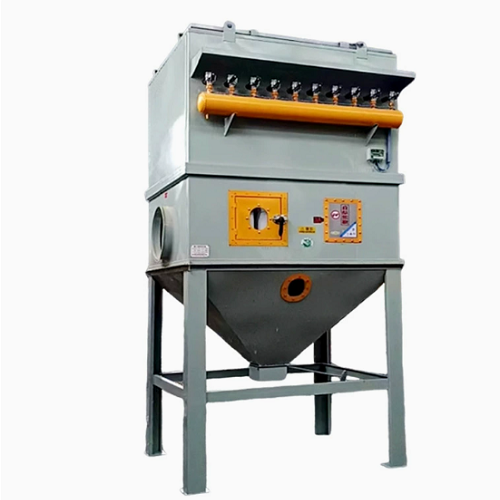
Welding Fume Collection for Steel Fabrication Workshops
Welding fume control begins at the arc. The challenge in a steel fabrication shop is not simply total airflow: it is keeping the capture point near moving work, while avoiding a hood arrangement that disrupts shielding gas or blocks the operator.
Choose the capture method by workstation
| Work pattern | Capture direction |
|---|---|
| Fixed bench welding | Backdraft, downdraft or articulated extraction arm positioned close to the arc. |
| Large assemblies | Mobile arms, zoned hoods or a ventilated enclosure sized around access needs. |
| Robotic cells | Enclosure capture with interlocked extraction is usually easier to stabilize. |
| Occasional repair work | A mobile unit may be more practical than a large central duct system. |
Collector choice and fire considerations
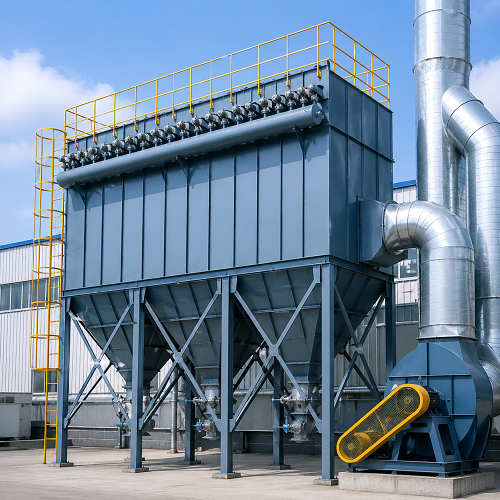
Fine metal fume is commonly handled with cartridge filtration, provided the dust characteristics and spark risk are evaluated. Keep combustible dust assessment, spark control, grounding, duct routing and isolation needs in the project scope. Do not treat a cartridge collector as a universal fire-control device.
Airflow must follow capture geometry
Start with the hood opening, distance to arc, cross-drafts, worker position and number of simultaneous stations. A large fan cannot restore performance when the pickup point is too far away. Duct branches should be balanced for the stations that run together, not just for the number of branches shown on a drawing.
Commissioning checks
- Observe visible fume travel at real welding positions, including awkward orientations.
- Check differential pressure and cleaning performance after normal production begins.
- Confirm hood position does not create an unacceptable draft at the weld.
- Train operators to reposition extraction arms as part of the work sequence.
For a workable proposal, provide welding processes, electrode/wire type, number of simultaneous stations, workpiece size, indoor layout, available power and any combustible-dust information.